
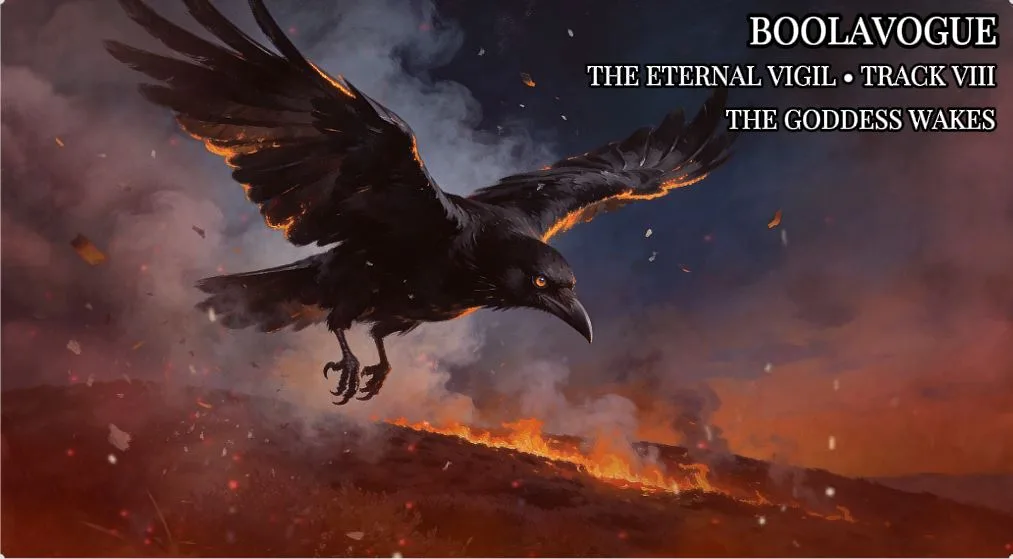
Figure in this songThe Morrígan
The legend behind this song
Seventy Years of Silence. Then the Chapel Burned.
"Boolavogue" is the eighth chapter of "The Eternal Vigil" — the moment the goddess finally wakes.
On the night of May 26th, 1798, yeomen burned Father John Murphy's chapel at Boolavogue in County Wexford. Murphy — a priest who had counseled patience and obedience — took up the fight. Within days, farmers armed with pikes had risen across Wexford. They won at Oulart Hill. They held for weeks. And then, at Vinegar Hill, the empire brought its cannon, and it ended the way these things end.
For two centuries the Morrígan had gone cold. She watched the earls sail into exile. She watched the language fined into silence under the Penal Laws. A war goddess with no warriors to choose. But when the heather blazed at Boolavogue, something turned. She came down into the smoke — not to win the day, but to choose who walked into the sky. And when it was over, she knelt beside the croppy boys buried face-down in the dirt, rye seed in their pockets so the grain might grow from their graves.
She has walked ten thousand battlefields. She has never wept like this.
She slept through the silence. She will not sleep through this.
Historical Context: The Wexford Rebellion of 1798 was the bloodiest single campaign of the United Irishmen's rising. Father John Murphy of Boolavogue led his parishioners into revolt after the burning of his chapel, winning early victories at Oulart Hill and Enniscorthy. The rebellion was crushed at the Battle of Vinegar Hill on June 21st, 1798. Murphy was captured, tortured, and executed — his body burned, his head displayed on a spike. Rebels were buried face-down in mass graves; legend holds that some were buried with rye in their pockets, and that the grain later grew from the soil of the croppies' graves — immortalized in the ballad "The Croppy Boy." An estimated 20,000 died in Wexford alone.
"They planted rye. They planted fire. They planted something I cannot carry.", Which line moved you most? The saga continues...