
Figure in this songThe Morrígan
The legend behind this song
A War Goddess in a Country With No War Left to Fight.
"An Gorta Mór" — The Great Hunger — is the ninth chapter of "The Eternal Vigil," and the one she has no name for.
Between 1845 and 1852, the potato blight destroyed the food of the Irish poor. A million died. A million more emigrated. The population of Ireland fell by a quarter, and has never fully recovered to this day. But the horror at the center of the Great Hunger is not the blight — it is that throughout the worst years, Ireland continued to export food. Grain, cattle, butter, and oats sailed out of Irish ports under armed guard while the people who grew them starved in sight of the ships.
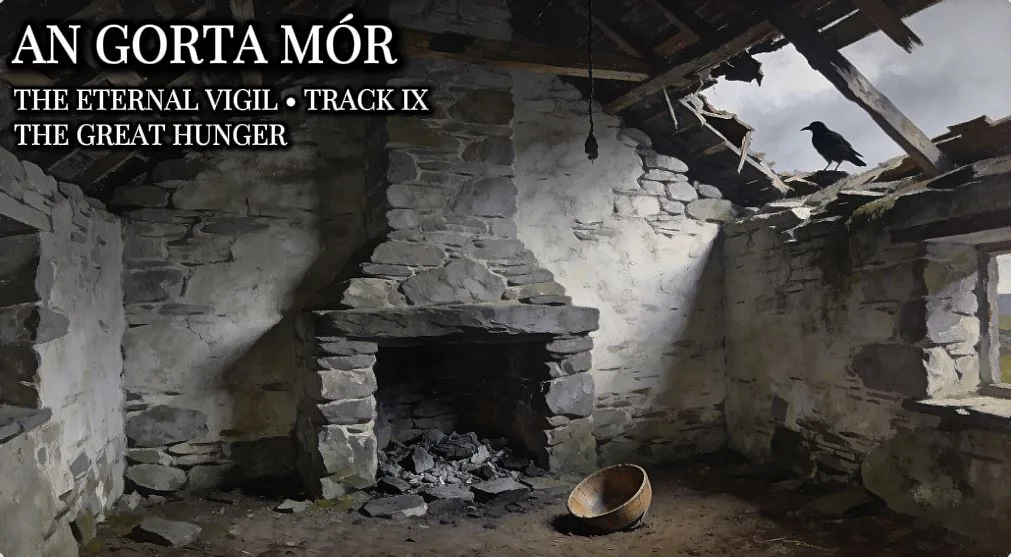
The Morrígan is a war goddess. She knows how to choose the slain, how to walk a battlefield, how to mark the brave and curse the enemy. But the Great Hunger is not a war. There is no field, no charge, no army to name. The dead did not fall with iron in their hands — they died in ditches with their mouths stained green from eating grass. For the first time in all her centuries, she finds death she has no authority over, no role in, no name for. She comes down looking for the slain and finds only the starved, and she cannot claim a single one.
This is the bleakest song in the saga. It does not resolve. There is no rye seed in these graves.
She woke at Boolavogue. Now she learns there are catastrophes no waking can answer.
Historical Context: An Gorta Mór (the Great Hunger) was caused by Phytophthora infestans, a blight that destroyed successive potato harvests beginning in 1845. The potato was the sole food of roughly a third of the population. While the crop failed, Ireland remained a net exporter of food throughout the famine — grain, livestock, and dairy left the country under military and constabulary guard, sold to pay rents to often-absentee landlords. The British government's response, shaped by laissez-faire economic doctrine, was widely regarded then and now as catastrophically inadequate. Mass evictions cleared the starving from the land; "coffin ships" carried emigrants across the Atlantic in conditions that killed many before they arrived. By 1852, approximately one million had died and a million more had emigrated. 1847 — "Black '47", was the worst year.
"There is no rye seed in these pockets. There is nothing growing here.", Which line stayed with you? The saga continues...