
Figure in this songThe Morrígan
The legend behind this song
They Lost the Week. They Won the Country. It Took Sixteen Men and a Prison Yard.
"Sixteen" is a chapter of "The Eternal Vigil" — the debt called in.
On Easter Monday, 1916, a schoolteacher named Pádraig Pearse stood on the steps of the General Post Office in Dublin and read a proclamation of the Irish Republic to a street that laughed at him. For six days, roughly 1,600 rebels held the city center against an empire. Dublin burned. The rebels surrendered. As they were marched to prison, their own city jeered them.
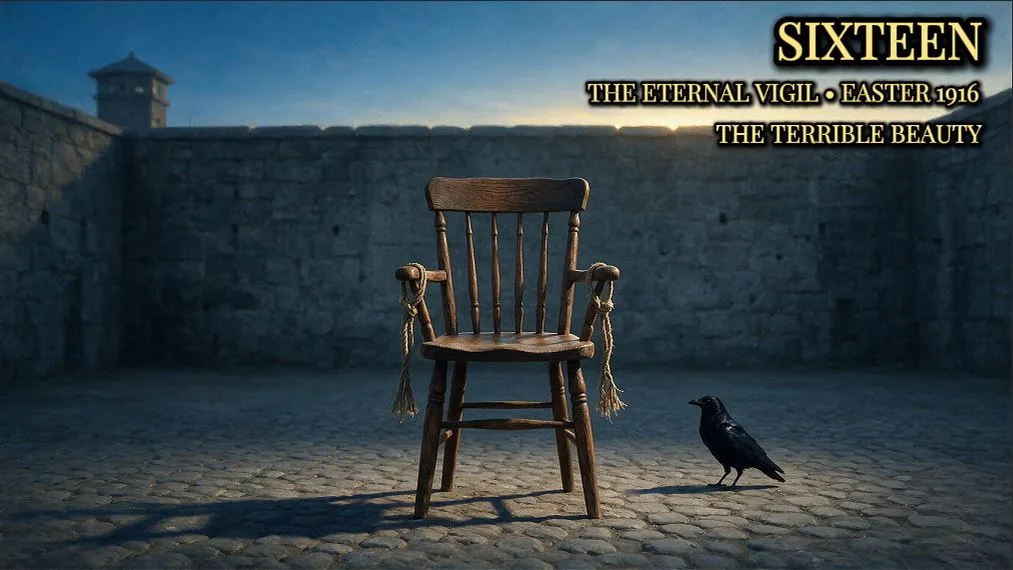
Then the executions began — and everything changed. Between May 3rd and May 12th, the leaders were shot one by one, in ones and twos and threes, in the yard at Kilmainham Gaol. James Connolly, his leg shattered by shrapnel and gangrene setting in, could not stand to face the firing squad. They carried him out on a stretcher, tied him to a chair, and shot him sitting down. Sixteen men in all. And with every volley, the crowds that had jeered on Easter Monday turned. By summer, the sixteen were martyrs. Within six years, the empire was negotiating its exit.
The Morrígan told us at the end of the Land War: they will need me again. Now the call has come — but it comes with a bitterness only she can name. Her people had already proven the pen could win the land. They had shown her a war without graves. And the schoolteacher chose the altar anyway.
She answers the call. She never said she'd be glad.
The Morrígan Saga: "The Eternal Vigil" (Album 2) continues the story from "The Cycle of Crows" (Album 1) — the Morrígan's endless watch through Irish history, from ancient battlefields to the modern age. The vigil is nearing its end. One more field remains.
Historical Context: The Easter Rising began on April 24th, 1916, when members of the Irish Volunteers and the Irish Citizen Army seized key buildings in Dublin, headquartered at the General Post Office. Militarily, the Rising failed within six days. Politically, the British response transformed it into the founding event of modern Ireland: sixteen leaders were executed, including all seven signatories of the Proclamation. Pearse had written openly of blood sacrifice as national redemption; whether the leaders expected victory or martyrdom remains debated by historians. What is not debated is the effect — public opinion swung decisively behind the republican cause, Sinn Féin swept the 1918 election, and the War of Independence followed within three years. W.B. Yeats wrote the event's epitaph: "All changed, changed utterly: A terrible beauty is born."
"A man who cannot stand is a man who cannot kneel." — Which line hit hardest? One more field remains...